Author: Mikkel

NGC’s New 1.5 MW Coolant Distribution Unit

Up to 1.5 MW of cooling through a single unit, with no built-in pump and a maximum of 100 W. That is three times the capacity of our previous largest CDU, built for multi-megawatt data centres.

Why size matters at system level

As AI and high-density racks push data centres towards multi-megawatt cooling loads, the number of CDUs in a system becomes a design question in its own right. Every additional unit adds connections, controls and floor space. A CDU that carries 1.5 MW lets the facility side of the cooling system stay simpler: fewer units, fewer interfaces and one defined point between rack-level cooling and the facility’s cooling source.

What the numbers mean in operation

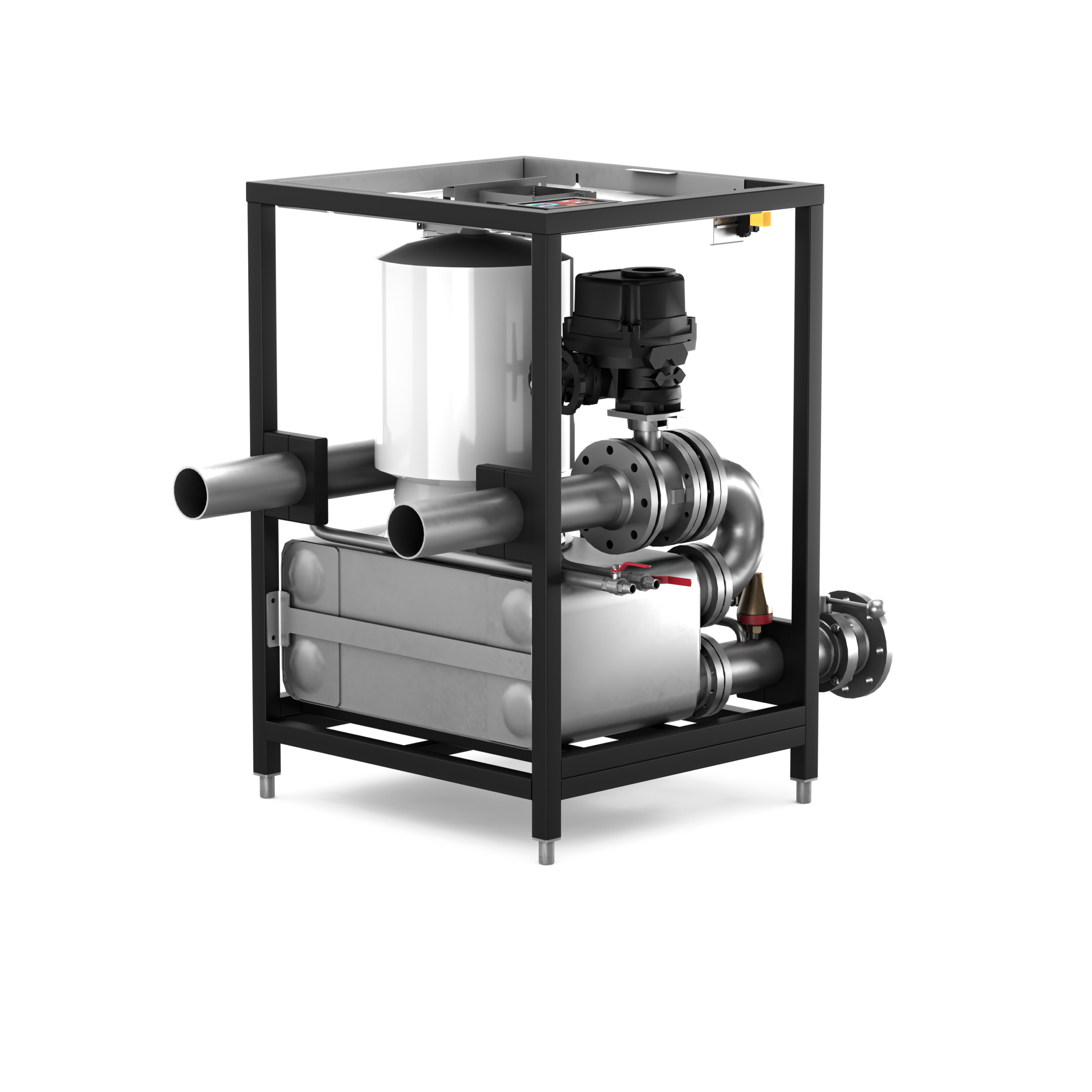
The 1.5 MW Passive CDU delivers a secondary flow of up to 60 m³/h with a pressure drop of 0.2 bar through DN100 connections. Its capacity is rated at 40 °C inlet and 18 °C outlet. The higher the return temperature the system allows, the more of the year the facility can run on free cooling. We explain the physics in The chiller that uses 42 % of the power for 2.3 % of the cooling.

Under changing load, an ultra-fast modulated valve takes the CDU from idle to full load in 6 to 8 seconds. The CDU predicts the new operating point and reacts 2 to 4 seconds before warmer fluid reaches it. The supply temperature to the racks stays within its limits while the load moves.

Inside the 1.5 MW Passive CDU, showing the DN100 connections and the Alfa Laval heat exchanger
Inside the 1.5 MW Passive CDU: DN100 connections and Alfa Laval plate heat exchanger.

Designed for long operation

The 1.5 MW Passive CDU contains no components that require service. A yearly inspection is recommended. It integrates with building management systems via Modbus TCP, SNMP and BACnet, with Redfish available on demand, and can be supplied with dual power supply for redundancy.

Explore it

See the 1.5 MW Passive CDU in 360° on the product page, look inside the unit in the interactive feature guide, or download the datasheet.

What Viborg Can Teach Us About Data Centre Heat Pumps

How much electricity does a data centre heat pump need to turn surplus heat into district heating? Mostly, it depends on one number: the temperature of the water leaving the data centre. Viborg Varme expects a heat pump COP of about 5 when it lifts 30 to 42 °C water from Apple’s data centre and Energinet’s substation to 70 °C. That means about 80 % of the delivered heat comes from surplus heat and 20 % from electricity (Dansk Fjernvarme, April 2026).

Our LinkedIn post about Viborg drew more questions than anything we have published. Here are the answers.

What is happening in Viborg?

From the second half of 2027, Viborg Varme will take surplus heat from Apple’s data centre and Energinet’s transformer station at Tjele. The first stage is 12 MW, with a potential of up to 69 MW over time. Storage tanks will receive the 30 to 42 °C water every day of the year before an isobutane heat pump raises it to 70 °C (Dansk Fjernvarme). Viborg Varme puts its investment at DKK 210 million and expects surplus heat to cover half of its heat supply in 2027 (Dansk Fjernvarme, October 2026).

Why does the lift decide the COP of a data centre heat pump?

The bigger the temperature gap, the more work the compressor does for each kWh of heat. Physics sets a ceiling: the theoretical maximum COP is the network temperature divided by the lift, both in kelvin. Lifting 42 °C water to 70 °C gives a ceiling of about 12. Lifting 30 °C water gives about 8.6. Real machines reach only part of that ceiling, so an expected COP of about 5 sits well below it.

A COP of 5 means that 1 kWh of electricity plus 4 kWh of surplus heat gives 5 kWh of district heat. That is where the 80 % comes from.

Is “80 % free” heat really free?

No. As one reader pointed out, electricity is worth more than heat. The 80 % describes energy, not cost. The utility still pays for pipes, heat pumps, electricity and operation. For the business case, this is the point: every degree of lift you remove is electricity you do not have to buy for the lifetime of the plant.

How warm can the water from a data centre be?

It depends on the cooling technology and on how warm the servers run. Typical return temperatures in Danish data centres are:

  • Room cooling (CRAH/CRAC): around 12 °C
  • Rear-door heat exchangers: 20 to 34 °C
  • Direct-to-chip cooling: around 42 °C
  • The newest NVIDIA generation (Rubin): around 45 °C

Against a 70 °C network, that is the difference between a lift of almost 60 degrees and a lift of 25.

Do servers have to be special to deliver 56 °C water?

This was the most common question. ASHRAE recommends 18 to 27 °C at the server inlet for the best long-term reliability. The allowable range is wider: up to 32 °C for class A1 and up to 45 °C for class A4 (ASHRAE TC 9.9, Thermal Guidelines, 5th edition).

A return temperature near 56 °C requires air leaving the servers at around 60 °C, so the servers must run at the warm end. That is a deliberate choice to make with the IT supplier. Several readers noted that cooler chips tend to last longer. That trade-off is real and belongs in the decision.

Who cools the data centre when the heat is not needed?

In Viborg, the heat utility takes the heat but delivers no cooling in return (Viborg Varme, presentation to the Danish Parliament’s Energy Committee). The data centre must still cool itself. Readers also suggested low-temperature networks for new homes, where less of the heat needs lifting. The whole chain from server to radiator must be optimised, not one link.

Does liquid cooling change the calculation?

It delivers warmer water, so the lift shrinks. In Sønderborg, the Bitten AI supercomputer at the University of Southern Denmark uses liquid cooling to recover all its waste heat for the town’s district heating network (Al Jazeera, November 2026). Recovered heat still only has value where a network can take it.

What have we learned at NGC?

In the solutions we design, supply and return are typically 18 to 22 °C and 38 °C when server exhaust air is 45 °C. Return can reach up to 56 °C when exhaust air is 60 °C. Lifting 56 °C water to 70 °C is half the lift of 42 °C water.

Higher return temperature also means lower flow, less infrastructure and more hours of free cooling. But surplus heat is only valuable when temperature, flow, distance and system design fit together, as we described in The Value of Hot Water and Data Centre Heat Reuse: Kalundborg, Ølgod and the Cost of Distance. Read more about RDHx Active Flow.

FAQ

What COP can a heat pump reach on data centre heat?

It depends mainly on the lift. Viborg Varme expects about 5 when lifting 30 to 42 °C water to 70 °C.

Can data centre heat be used without a heat pump?

Only where the network runs close to the temperature of the water, such as low-temperature networks for new buildings. A 70 °C network like Viborg’s needs a heat pump.

Sources

This article builds on Ole Kristensen’s LinkedIn post about Viborg and the questions in its comments.

Why a Chiller Can Use 42 % of the Power and Still Be Right

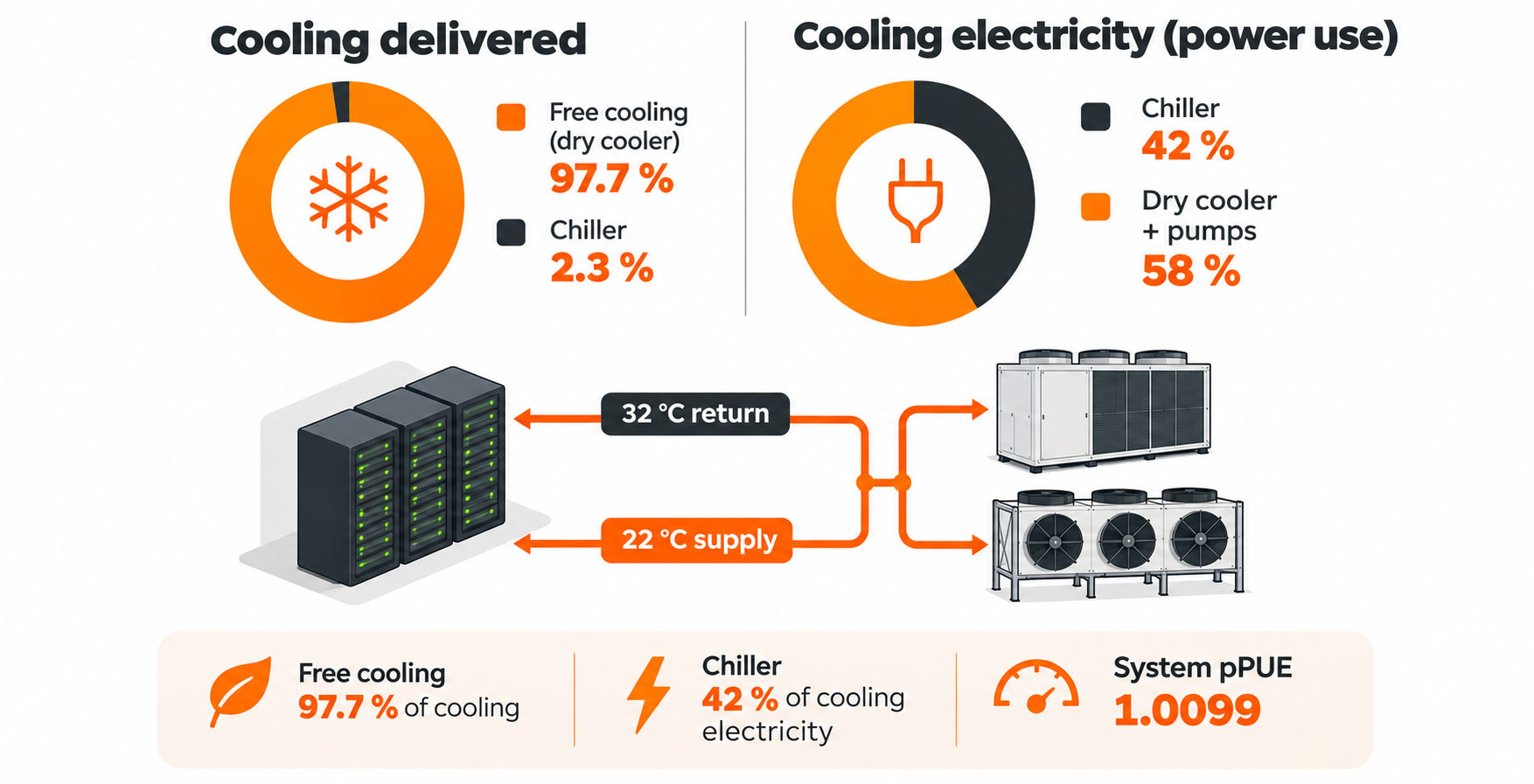
In a well-designed data centre cooling system, the chiller can use a large share of the cooling electricity and still do only a small part of the work. In one calculation for a typical Danish year, free cooling with a dry cooler delivered 97.7 % of the cooling. The chiller used 42 % of the cooling electricity to deliver the last 2.3 %. That is not a fault. It is what happens when the chiller only handles the warmest hours.

The numbers come from a LinkedIn post that started a useful discussion among engineers. This article explains the calculation and the physics behind it, and answers two questions from the comments.

What did the calculation show?

At Next Generation Cooling, we calculated a full year of cooling at 22 °C supply and 32 °C return, running around the clock. We used hourly temperatures for a typical year at Tirstrup (Aarhus Airport) from the Danish Meteorological Institute, DMI. Free cooling through the dry cooler delivered 97.7 % of the cooling, and the chiller covered the remaining 2.3 %. The calculated pPUE for the whole cooling system was 1.0099.

This is a calculation, not a measurement. The free cooling share always depends on supply temperature, climate and design. In another optimised case, it was 92 to 96 %.

Infographic: free cooling with a dry cooler delivers 97.7 % of the cooling, while the chiller delivers 2.3 % but uses 42 % of the cooling electricity. System at 22 °C supply and 32 °C return, calculated pPUE 1.0099.
Calculated full year at Tirstrup, 22 °C supply and 32 °C return. The chiller does 2.3 % of the cooling but uses 42 % of the cooling electricity.

Why can a dry cooler handle most hours of the year?

A dry cooler uses outdoor air and fans to cool the water, with no compressor. It can bring the water down to around 4 °C above the outdoor temperature. With a 22 °C supply, it can carry the full load whenever it is below about 18 °C outside.

According to DMI, Denmark’s normal annual mean temperature is 8.7 °C, based on the 1991 to 2020 climate normal. That puts most hours of the year well below 18 °C.

On the warmest hours, the dry cooler cannot bring the water all the way down. Then the chiller takes over, but only for the last few degrees.

Why does the chiller use 42 % of the power?

A chiller uses a compressor to lift heat to a higher temperature so it can be released outside. That takes energy. A chiller can use up to 10 times as much energy per kW of cooling as free cooling.

So even a small share of the work shows up as a large share of the electricity. In the calculation, 2.3 % of the cooling became 42 % of the cooling power. Because the total is so low, the whole system still ends at a calculated pPUE of 1.0099.

Warm water helps the chiller too. The warmer the water it receives, the smaller the temperature lift to outdoor air, and the more efficiently it runs. The rule is simple: let free cooling take the heat first, and leave only the remainder to the chiller.

What happens if the system runs on colder water?

Turn the design around and the picture changes. In a system running on 12 °C supply water, the dry cooler can only carry the full load when it is below about 8 °C outside. In a Danish climate, that is a much smaller share of the year. The chiller becomes the workhorse instead of the backup. We explain the wider trade-off in The Value of Hot Water.

For the operator, this is the economic point. Higher supply and return temperatures mean more hours of free cooling and fewer hours of compressor cooling. The chiller becomes insurance against the warmest hours, not the item that sets the electricity bill. Read more on our energy efficiency page.

Does a warm year change the result?

Yes. The calculation uses a typical year and constant load. In 2025, Denmark’s mean temperature was 9.7 °C, 1.0 °C above the 1991 to 2020 normal, according to DMI. In a year like that, the chiller’s share rises. In a warmer climate than Denmark’s, the calculation looks different again. The principle stays the same: the higher the supply temperature, the more of the year free cooling can cover.

FAQ

Is free cooling the same as a dry cooler?

Not quite. Free cooling is the operating mode: cooling without a compressor. A dry cooler is one way to achieve it. A chiller can also work together with a dry cooler, so the two are not always separate machines.

How do you know how much energy the chiller actually uses?

Measure it. Separate sub-meters on the chiller, the dry cooler fans and the pumps show where the cooling electricity goes. Without them, a high chiller share is easy to miss, and so is a well-performing system.

What supply temperature gives the most free cooling?

The higher, the better, within what the IT equipment and cooling units allow. In our designs, supply is typically 18 to 22 °C. At 22 °C, free cooling can carry the full load below about 18 °C outside.

Sources

  • DMI, Danmarks klima 2025 (DMI Report 26-04): 2025 mean temperature 9.7 °C, 1.0 °C above the 1991 to 2020 normal
  • DMI, hourly temperature data for Tirstrup (Aarhus Airport), typical year, via DMI’s open data API
  • Next Generation Cooling, cooling calculation for Tirstrup at 22/32 °C, whitepaper section 6.2

This article builds on a LinkedIn post by Ole Kristensen, CTO: read the original post and the discussion.

Data Centre Heat Reuse: Kalundborg, Ølgod and the Cost of Distance

Two Danish data centre projects made the news in October 2026. Both promise to reuse their surplus heat. Neither is built yet, and both still depend on decisions made outside the data centre fence. But they give very different answers to the same basic question: where is the buyer of the heat?

In Kalundborg, the heat is meant to travel towards Copenhagen, through a pipeline that has not yet been decided. Near Ølgod, the buyer is planned on the same site. This article looks at both projects and at the engineering underneath the promise.

Kalundborg: 850 MW and a pipeline still on the drawing board

A data centre with 850 MW of grid capacity is being planned in Kalundborg, on around 150 hectares south of the town’s industrial park. The project still needs permits and the municipality’s final decision. The developer says the surplus heat will go to district heating, and estimates that it could cover 25 to 30% of the district heat Copenhagen will be short of in 2050. The argument rests on a planned district heating line from Kalundborg to the capital.

That line already has a history. Since 2025, a consortium of VEKS, Novo Nordisk, Holbæk and Kalundborg municipalities, Kalundborg Forsyning and Ørsted has studied a transmission line that would carry industrial surplus heat from Kalundborg towards the Copenhagen area. Ingeniøren described it as more than 100 km of buried pipe. The partners have chosen a route that connects to the capital’s network at Roskilde and delivers heat along the way in Kalundborg and Holbæk. They are still working out whether a municipal project company should build it.

The idea is not new. Ingeniøren reported in March 2025 that the project had been on the drawing board for several years, stalled in 2024 when it proved too expensive and risky, and was then revived by Novo Nordisk.

VEKS has been open about the economics. The project is cost heavy, requires depreciation over up to 50 years, and carries more risk than the utility’s other surplus heat projects. Ownership of the line, during both construction and operation, is still to be settled.

There is one more detail. The line was conceived for industrial heat, and Kalundborg already has more surplus heat than it can use locally. A VEKS memo assumes that the industrial symbiosis in Kalundborg can produce more than 220 MW of surplus heat, of which VEKS estimates it can take around 120 MW. Heat from a new data centre would have to find room in a pipeline planned for someone else’s heat. The data centre’s heat promise rests on infrastructure that was developed for industry, and that has not yet been decided.

Ølgod: the buyer on the same site

On 6 October 2026, Varde Municipal Council approved the local plan for a combined data centre and greenhouse project at Krageris, north of Ølgod. The 174 hectare site allows up to 225,000 m² of data centre and up to 475,000 m² of greenhouses. The surplus heat is to warm the greenhouses so that vegetables can be grown all year. atNorth leads the project, Selected Group will build and run the greenhouses, and completion is expected in 2030.

Here the heat does not need a long transmission line. The source and the buyer are planned together, in the same local plan, from the start.

A third model: the network next door

Denmark already has a working example that sits between the two. Microsoft’s data centre in Høje-Taastrup supplies surplus heat to VEKS. It works because the data centre lies close to existing heat infrastructure and a residential area. VEKS installs heat pumps that raise the temperature before the heat is sent into the district heating network.

The physics: heat loses value with distance

Moving heat costs in three ways. The pipe has to be dug in. Pumps use electricity to move the water. And the water loses heat on the way. All three grow with distance. A line of more than 100 km is not a connection, it is a long-term infrastructure asset that has to be financed and maintained for decades.

Friction is a large part of that bill. Long heat lines have always been a fight against it, with engineers looking at everything from larger pipe diameters to additives that help the water flow more easily. Materials and pumps have improved, but the principle has not changed: every kilometre is paid for in pumping energy, year after year.

Temperature changes the calculation. A data centre delivers low-grade heat. In the designs we work with, return water reaches up to 56 °C when servers run with 60 °C exhaust air, and around 38 °C at 45 °C exhaust air. How warm the water gets depends on how warm the operator is prepared to run the servers.

The warmer the water, the lower the flow needed to move the same amount of heat. Lower flow means smaller pipes, smaller pumps and less equipment, both inside the data centre and on the way to the buyer. Warmer water also leaves less work for any heat pump that has to lift the temperature to network level.

Season matters too. Residential district heating demand falls in summer, while a data centre produces heat all year. A greenhouse built to produce year round gives the heat a use outside the residential heating season.

What to ask before counting the heat

Long transmission lines can make sense. A capital region is a large and stable buyer, and Kalundborg’s industrial heat is real. But distance is a bill, and someone pays it for many years.

For a municipality or a utility, the first question is therefore not how much heat a data centre promises. It is who takes the heat, how close they are, at what temperature, and in which months. The next questions follow from the answers: who builds and owns the pipe, and who carries the cost over its lifetime.

Surplus heat is only valuable when temperature, flow, distance and system design fit together. The projects that answer those questions early are the ones most likely to deliver on the promise.

Sources

Residual Heat in Liquid-Cooled Racks: Why Air Still Matters

News and Insights

A liquid-cooled GPU rack still sends part of its heat to the room air. In the NVIDIA GB300 NVL72 reference design, about 10% of the rack’s heat goes to air, which is roughly 14 kW per rack. That is more than the most common rack in today’s data centres draws in total, and it has to be cooled with much colder water than the chip loop needs.

How much heat does a liquid-cooled rack still send to air?

Direct-to-chip cooling only takes the heat that reaches the cold plates. In Lenovo’s product guide for the GB300 NVL72, the CPUs, GPUs and NVLink switches are liquid-cooled, while network modules, drives and power distribution are cooled by fans. At rack level, the split is about 90% to liquid and 10% to air.

NVIDIA’s reference architecture allows up to 142 kW per GB300 NVL72 rack. Ten per cent of that is about 14 kW. For comparison, Uptime Institute’s 2026 Global Data Center Survey puts the most common rack density at 11 kW, and the average at 7.8 kW when facilities built for more than 30 kW are left out.

In our own designs, chip-cooled racks of 100 kW and below typically leave around 25 kW in the air. Newer, more powerful racks leave less, down to about 15 kW. Earlier GPU generations sent up to 20 to 30% of their heat to air.

Why does the air side need colder water than the chip loop?

A cold plate sits directly on the chip, so the water can be warm and still carry the heat away. At CES in January 2026, NVIDIA said its Vera Rubin racks can be cooled with 45 °C supply water, with no water chillers needed.

Air is different. The heat first has to pass from the components into the air, and then from the air into a water coil. Every step costs temperature. That is why the air side runs on much colder water. In Danish data centres, typical supply temperatures are 6 to 7 °C for CRAH and CRAC units and 12 to 21 °C for rear-door heat exchangers. Our rear-door designs typically run on 18 to 22 °C supply water.

When does a dry cooler stop being enough?

A dry cooler can cool water to around 4 °C above the outdoor air. That rule decides when the chillers start.

  • 45 °C supply water works whenever it is below about 41 °C outside. In Denmark, that is practically all year.
  • 20 °C supply water only works when it is below about 16 °C outside.

Above that, a chiller has to take over, and a chiller can use up to 10 times as much energy per kW of cooling as a dry cooler. So a hall can have a chip loop that never needs a chiller and an air side that still does. Several liquid cooling experts made the same point after NVIDIA’s announcement: warmer chip water reduces the need for chillers, but it does not remove it.

What does the air-side temperature mean for the energy bill?

The chiller is the expensive part, so the goal is to let the dry cooler take as much of the heat as possible and leave only the rest to the chiller. A chiller also works more efficiently the warmer the water it receives, because the temperature lift to the outdoor air is smaller.

Every degree warmer on the air side adds hours of free cooling. In one optimised case of ours, free cooling covered 92 to 96% of the year. In a calculation for a typical year at Tirstrup near Aarhus, running 24/7 at 22/32 °C, the dry cooler delivered 97.7% of the cooling and the chiller 2.3%. The chiller still used 42% of the cooling power. That is a calculation, not a measurement, but it shows where the energy goes: into the few hours the air side cannot be cooled for free.

For a CFO, the air-side supply temperature decides whether the chiller line leaves the budget, or only gets smaller. More on this on our Energy Efficiency page.

How do rear doors handle residual heat from chip-cooled racks?

A rear-door heat exchanger removes the heat at the back of the rack, before it reaches the room. That makes it a good match for the residual heat from chip-cooled servers, including NVIDIA GPU racks from Dell, Lenovo and Supermicro. Our RDHx Active Flow mounts directly on existing racks, so it needs no extra white space, and it can be retrofitted without rebuilding the building. The water comes from our modular CDU, with a capacity of up to 1200 kW. You can read more about the temperature side in The Value of Hot Water.

FAQ

Does direct-to-chip cooling remove the need for room cooling?

No. In the GB300 NVL72 reference design, about 10% of the heat still goes to air, roughly 14 kW per rack at 142 kW.

What supply temperature do rear-door heat exchangers use?

In Danish data centres, typically 12 to 21 °C. Our designs typically run on 18 to 22 °C.

Can free cooling handle the air side in Denmark?

Most of the year, depending on supply temperature, climate and design. In one optimised case, free cooling covered 92 to 96% of the year.

Sources

This article builds on a LinkedIn post from 19 October 2026.

Continue reading

EU Data Centre Label: What Class A PUE 1.15 Really Takes

To get class A on the EU’s new data centre label, a site needs a power usage effectiveness (PUE) of 1.15 or less. The average reported across the EU is 1.36. Closing that gap means cutting the energy spent outside the IT equipment by more than half, and for most sites the realistic place to start is cooling.

What is the EU data centre rating scheme?

On 21 September 2026, the European Commission adopted a delegated regulation that creates a common EU rating scheme for data centres. It applies to sites with an installed IT power demand of 500 kW or more, which already report energy and water data under the Energy Efficiency Directive.

Each site gets two grades from A to G: one for energy (PUE) and one for water (WUE). Class A requires a PUE of 1.15 or less, and class G applies above 1.9. For water, class A requires a WUE of 0.1 litres per kWh or less. The first labels are due by 15 August 2027, generated automatically from the data operators already submit.

The regulation is still in its scrutiny period with the European Parliament and the Council. In parallel, the Commission is consulting on binding minimum performance standards for data centres. That consultation closes on 14 December 2026.

How far is the average data centre from class A?

The Commission’s report from the first round of reporting puts the EU average PUE at 1.36, based on 681 data centres that reported a reliable value. On the label’s scale, where class C runs to 1.35 and class D to 1.5, that average would land in class D. The global average of 1.52 reported by Uptime Institute for 2026 would be class E.

A PUE of 1.36 means that for every kWh used by IT, another 0.36 kWh goes to everything else: cooling, power conversion losses, lighting. At 1.15, that overhead has to drop to 0.15 kWh. That is a reduction of almost 60 % in the energy used outside the IT equipment.

Why is cooling the main lever for PUE?

Power conversion losses can be reduced, but rarely by much without replacing the electrical infrastructure. Cooling is different, because its energy use depends heavily on one design choice: the temperature of the water it runs on.

Traditional room cooling often needs water at 6 to 7 °C. Making water that cold requires compressors for much of the year. Rear-door cooling typically runs on 12 to 21 °C, and chip cooling on 32 °C or more. Warmer water means more hours where outdoor air does the job through a dry cooler, and fewer hours with chillers running.

Does the label also rate water use?

Yes, and this is where many sites face a trade-off. Evaporative cooling, in cooling towers or adiabatic coolers, saves electricity and helps PUE. But it consumes water, which pulls the WUE grade down. The US national laboratory LBNL notes the same trade-off: evaporative systems are generally more energy efficient, while systems without evaporation use more energy.

The way to score well on both is again temperature. A dry cooler can bring water to about 4 °C above the outdoor temperature without evaporating anything. The warmer the cooling loop, the more of the year it can run that way.

Why can PUE get worse when utilisation is low?

Many data centres run well below their design load. Pumps, fans and power equipment have losses that do not fall in step with the IT load, so the overhead per kWh of IT rises. This is why operations matter as much as equipment: how the cooling is controlled at part load decides whether the design PUE is reached in practice.

Does class A say anything about resilience?

No. An annual PUE describes how efficiently a site ran over a year. It does not show how much load the site can carry through a hot day, a pump failure or a power event. Two class A sites can have very different safety margins. Redundancy, response time and how the cooling behaves when a component fails need to be assessed separately.

What have we measured in operation?

At Next Generation Cooling (NGC), we have measured a pPUE as low as 1.004 for our rear-door solution under real operating conditions, and 1.035 for the full cooling solution. pPUE covers cooling only, so it is not the same as a site PUE, but it shows how small the cooling overhead can become. At supply temperatures of 22 to 30 °C and return temperatures up to 56 °C, our solutions use up to 90 % less energy for cooling than room cooling. In Denmark, our designs use free cooling 92 to 96 % of the year, with no water evaporated to reject the heat. Redundancy is built in at door level, N+1 or N+2. Read more about energy efficiency and RDHx Active Flow.

FAQ

When will the first EU data centre labels appear?

The first labels are due by 15 August 2027, based on data operators already report.

Does class A mean the data centre uses green energy?

No. PUE measures how much energy is used per kWh of IT, not where the energy comes from. The label grades PUE and WUE only.

Which data centres are covered?

Data centres in the EU with an installed IT power demand of 500 kW or more.

Sources

This article builds on a LinkedIn post by Ole Kristensen and the questions raised in the comments.

Privacy Overview

This website uses cookies so that we can provide you with the best user experience possible. Cookie information is stored in your browser and performs functions such as recognising you when you return to our website and helping our team to understand which sections of the website you find most interesting and useful.